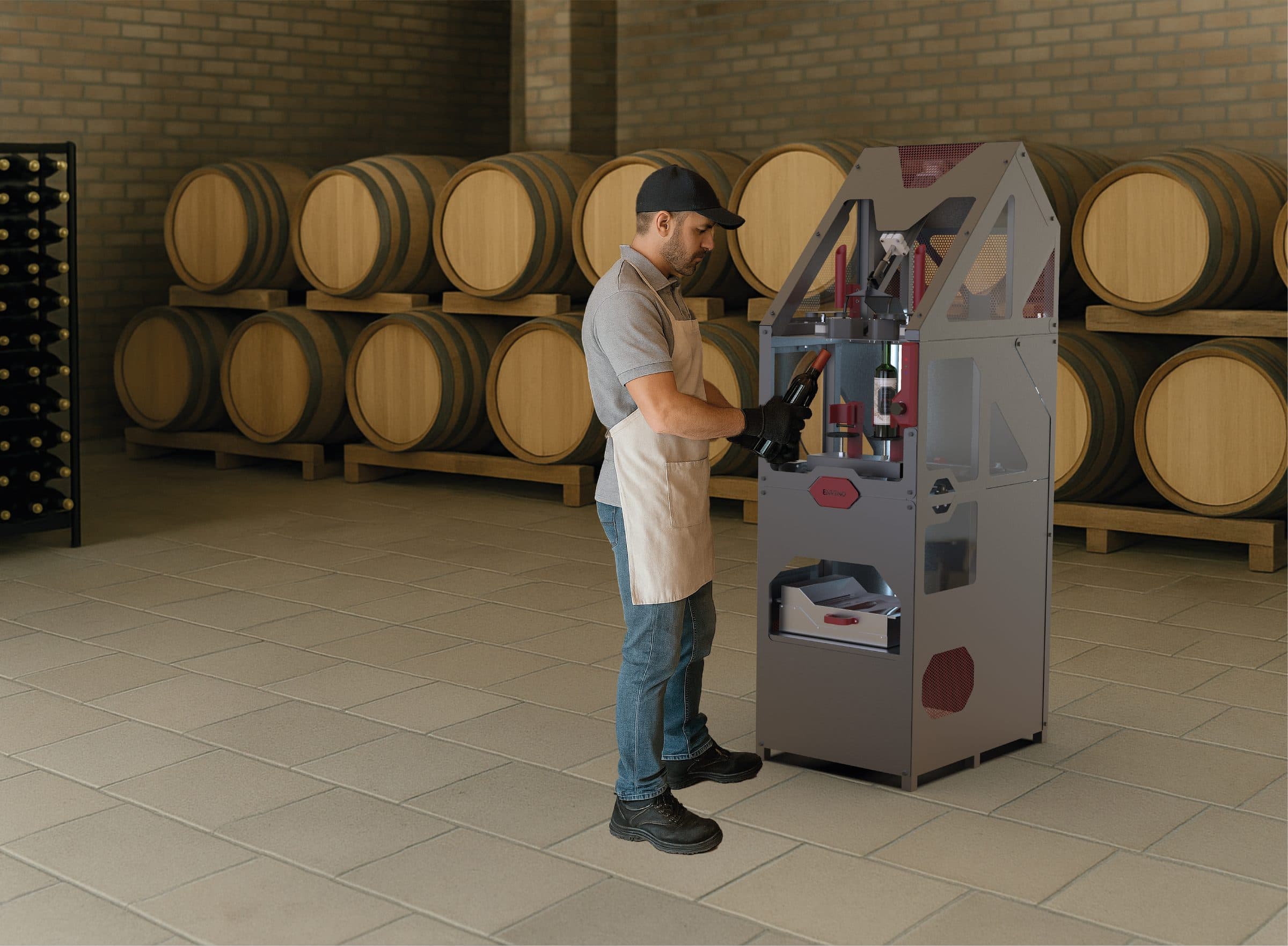
An operator loading a bottle into the envino machine in a winery, with oak barrels behind.
DT / 25 / 02

envino

Corking and wax-sealing machine for small wineries

Year
2025
Type
Product · Industrial equipment
Context
Tecnología IV, Cátedra Paglianiti — FADU/UBA
Team
Cosmedi / Falbo / Fernández Cicco / Hernández Figueroa / Tamaro / Zabala
Status
Prototype
01 / 11

Concept

Corking, wax-dipping and stamping in a single machine — the three finishing operations a small winery has to send out to somebody else.

envino corks wine bottles and seals their necks with wax. It was designed for the Argentine production context: it lets small wineries and SMEs bring an airtight closure and a distinctive handmade finish in-house, in one pass, and turn that finish into part of the brand.

The machine is split into two zones and that split is the whole design. The operator works the front — loading the bottles and choosing the mode — and everything after that runs on its own.

02 / 11
120
bottles per hour. Not a plant figure, and it is not meant to be one — it is the rate a semi-automatic line needs to hit to free a winery from hiring specialised labour.
≈16,000
bottles a year is what the small and mid-size wineries the machine is aimed at actually produce. Sizing the machine to that number is what keeps it affordable.
58 s
is the full cycle, from loading the bottles to taking them out: corking, a 180° turn, the wax dip, cooling and the stamp.
03 / 11

Sized for the cellar, not for the plant

The machine stands at working height and is operated from the front, in the same room where the wine is aged.

The envino machine standing in a cellar next to stacked oak barrels, with an operator working at the front.
04 / 11

Structure

A welded square-tube frame carries the three subsystems — corker, wax tray and stamping cams — and the sheet panels close it in.

The complete frame of the machine with the side panels removed, showing the corking pistons at the top, the bottle supports in the middle and the wax tray at the bottom.
  • 01
    Tube frame35×35×2 mm SAE 1010 steel, welded
  • 02
    Sheet panels1 mm SAE 1010 steel
  • 03
    Corking pistonLinear pneumatic actuator
  • 04
    SteppersThree NEMA 17 units
  • 05
    Cam and followerTurned AISI 1045
  • 06
    Wax trayPressed AISI 304 stainless
  • 07
    Heating elements550 W and 200 W, 220 V
  • 08
    Bimetal thermostatsFixed cut-off at 175 °C
  • 09
    FansTwo 24 V turbine fans, for cooling
  • 10
    Control panelSimatic S7-1200 PLC
05 / 11

Operating sequence

A hand placing a wine bottle on the fixed base of the machine.
  1. 01

    Load the bottles

    Set the catch and rest the bottle on the fixed base. Two bottles go through per cycle.

A hand pressing one of the three buttons on the control panel, next to the envino logo.
  1. 02

    Start the cycle

    Pick the mode the batch needs. This is where the operator's job ends.

The corking head lowered over two bottles held in their supports.
  1. 03

    Corking

    The pistons drive the cork into the neck. Corks drop from the hopper and the jaws guide them in.

Two bottles turned upside down over the tray of molten wax.
  1. 04

    Waxing

    The bottles turn 180° and dip into a tray of molten wax, which gives the neck its airtight seal.

The cam mechanism driving the two stamps horizontally against the bottle necks.
  1. 05

    Stamping

    A cam mechanism drives the seals horizontally and stamps the mark into the wax while it is still soft.

06 / 11

Three operations, one frame

The same structure serves the three stages. Shown without the side panels.

Side view of the frame with the corking piston lowered over a bottle.
01Corking
Side view of the frame with an arrow showing the bottle turning down towards the wax tray.
02Waxing
Side view of the frame with an arrow showing the bottle returning to the stamping position.
03Stamping
07 / 11

Jaws

A pair of jaws squeezes the cork before it reaches the bottle, so it enters the neck already compressed. Without them the piston would have to do that work against the glass.

The jaw mechanism shown open and closed, with a cork held between the two halves.
Close view of the corking head: two red hoppers, the central actuator and the two pistons over the bottle mouths.
08 / 11

Corking head

One pneumatic actuator drives both pistons. The corks fall straight out of the hopper and are guided into the jaws.

The wax tray drawer with its handle, shown above the heating elements and the thermostats that sit under it.
09 / 11

The wax tray

The tray holds the molten wax at two depths. Keeping a reserve at the deeper level means the wax stays pre-heated without cooking the mix already in use.

10 / 11

Parts and materials

Annotated view of the machine with callouts to the corking head, the bottle supports, the stamping unit, the control panel and the wax tray.

SAE 1010 steel

  • Cabinet sides, base and top
  • Cabinet front and back plates
  • Lid and hinges
  • Fan brackets
  • Frame tube, 35×35×2 mm

AISI 304 stainless

  • Pressed wax tray
  • Tray divider
  • Tray tabs
  • Tray base
  • Ø11 mm threaded rod, ×6

Turned AISI 1045

  • Cam
  • Followers, ×2
  • Stamping seals, ×2

Bought in

  • Simatic S7-1200 PLC
  • IP65 pushbutton station
  • T-handle cabinet lock
  • NEMA 17 steppers, ×3
  • 24 V turbine fans, ×2
  • Bimetal thermostats, 175 °C
  • 550 W and 200 W heating elements
11 / 11

What the machine is for

01

One process instead of three

Corking, waxing and stamping normally live in three different places, and for a small winery at least one of them means an outside service. Bringing them together is what makes the finish affordable at this scale.

02

Semi-automatic on purpose

Full automation would have priced the machine out of the market it was designed for. The operator loads and chooses; the machine does the part that needs to be repeatable.

03

The wax is the point

A wax seal is not only a closure: it is what a bottle uses to say who made it. The machine treats that finish as a brand decision, not a leftover step.

Contact me

This is the end of the portfolio — but only my first chapter. I believe there's still so much further I can go.

You can always find me at:

dantetamaro@hotmail.com

Buenos Aires · Argentina
2026

Available for remote work.

© 2026 Dante Tamaro — Industrial Design
Back to work