Three children around a classroom table with the jugaremos board on it; one of them plays from a wheelchair.
DT / 24 / 04

jugaremos

Cooperative game for children with cerebral palsy

Year
2024
Type
Product · Inclusive play
Context
Industrial Design IV, Cátedra Ferrero — FADU/UBA · with H.I.R.Pa.Ce and UCASAL
Team
V. Hernández / D. Tamaro
Status
Prototype
01 / 13

Concept

A board that turns, so that the child in the wheelchair plays the same round as everyone else instead of a version of it.

jugaremos is a cooperative table game for the classroom, developed with H.I.R.Pa.Ce — a rehabilitation centre for children with cerebral palsy in north-western Argentina — and the students of UCASAL.

The game brings the child in through play, with everyone taking part in the same process. It works against isolating one child inside a group setting: all of them carry out the same task, towards a shared goal.

02 / 13

Why it exists

1 in 500
births involves cerebral palsy.
40%
is roughly the share of children with cerebral palsy who attend mainstream schools in Argentina. The rest are educated apart.
48%
of people born with cerebral palsy have their cognitive capacity affected — which means that most do not.
80%
live with dysarthria, a physical difficulty in forming words. A quarter have no spoken communication at all.
03 / 13

What the condition does and does not do

Cerebral palsy can limit physical mobility, but it does not necessarily affect cognitive capacity or the wish to learn. These children often meet barriers that get in the way of taking a full part in school life — not because of their intellect, but because of the lack of tools that let them communicate, take part and learn alongside their classmates.

That distinction is the brief. The problem to design for was not the body: it was the missing tool.

04 / 13

The barriers we mapped

Five obstacles came up again and again in conversation with the centre. Only the first is physical.

  • 01Mobility in the school environment
  • 02Barriers to academic participation
  • 03Left out of extracurricular activities
  • 04Self-esteem and self-perception
  • 05Difficulty joining in with classmates
05 / 13

Everyone at the same table

The board sits on an ordinary classroom table at the height a wheelchair reaches, and it is played from any side.

Three children around a classroom table with the jugaremos board on it. One plays from a wheelchair, another leans on the chair beside him and a third watches from the far side.
06 / 13

The swivel joint

A ball joint under the board lets it tilt in every direction, and suction cups hold the base to the table. Tilting the board is how the group moves the ball — it takes more than one pair of hands, which is the point.

Close view of the underside of the board showing the ball joint and the side grip handle.
  • 01
    Ball jointMovement in every direction
  • 02
    Suction cupsHold the base to the table
  • 03
    Side gripsOne per player, snap-fitted
  • 04
    Maze wallsRemovable
  • 05
    Puzzle tilesInterlocking, laser-cut MDF
07 / 13

Two games in one board

The same frame takes two layouts. Which one is on the table depends on what the session is working on.

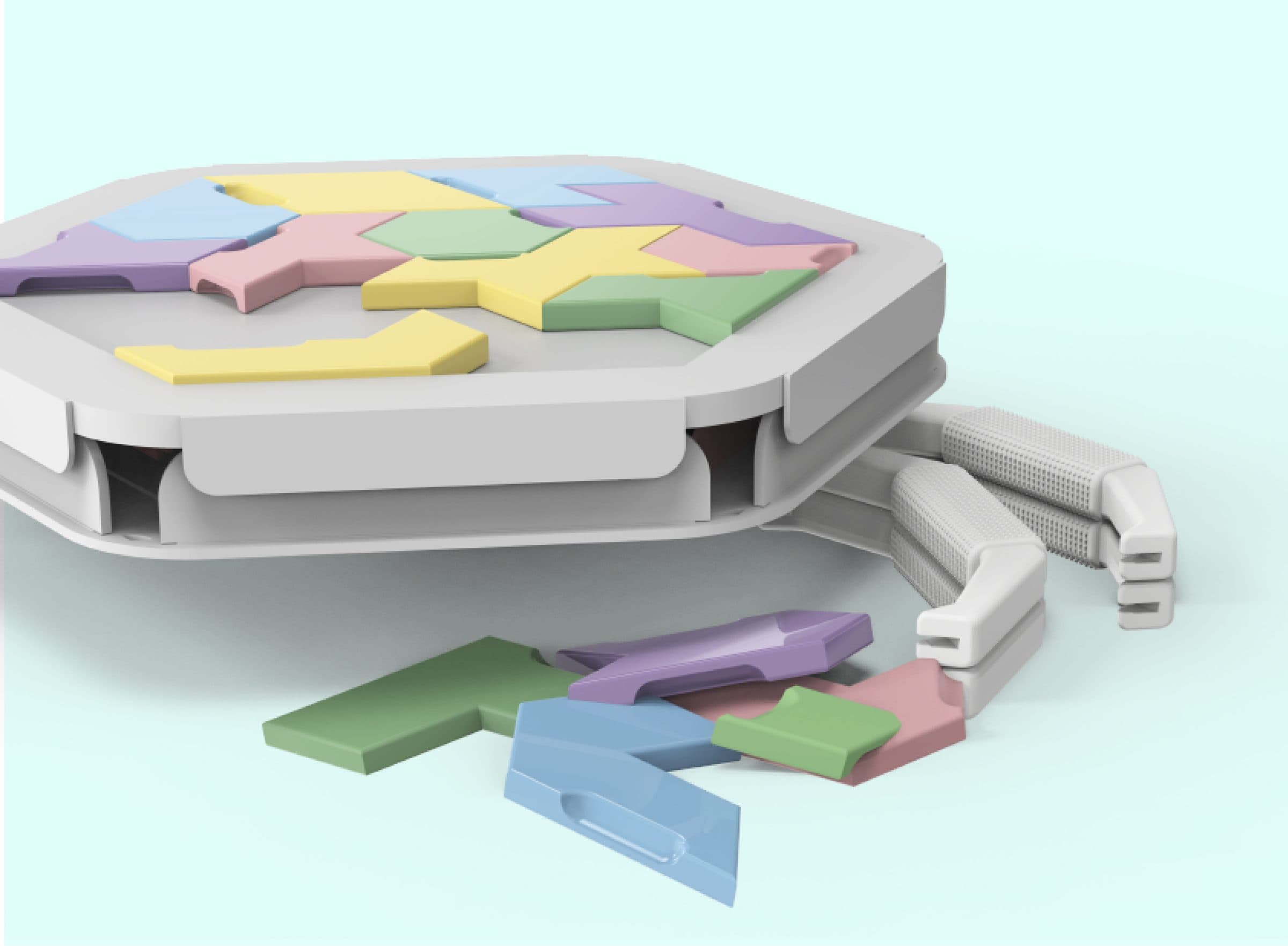
The board set up as a puzzle, with the coloured interlocking tiles laid out and some pieces scattered beside it.
01Puzzle layout — cognitive work, played seated and unhurried.
The board set up as a maze, with walls fitted on top and a ball resting inside the circuit.
02Maze layout — motor work, played by tilting the board together.
08 / 13

Setting it up

01

Maze

Fix the ball joint to the board, snap the walls onto the frame, drop in the ball. From there the group has to get it round the circuit and into the hole without anyone being able to do it alone.

02

Puzzle

Set the flat base down, separate the tiles and put them back in place. It has more than one valid solution, so the game does not become a memory exercise once it has been played through.

Five hexagonal diagrams, numbered one to five, each showing a different valid arrangement of the puzzle tiles.
09 / 13

More than one way to solve it

The puzzle resolves five different ways. That is what keeps it from going stale after the first session, and what makes it worth arguing about as a group.

10 / 13

Maze layout

Exploded view of the maze layout with callouts to the ball, the maze walls, the side walls, the base, the upper and lower ball joint, the side grip and the suction cups.

MDF, 3 and 5.5 mm

  • Board base
  • Interlocking side walls
  • Puzzle tiles
  • Maze walls

PLA, FDM printed

  • Upper ball joint
  • Lower ball joint
  • Side grips
  • Suction cup mounts
Exploded view of the puzzle layout showing the coloured tiles above the stacked frame and the interlocking MDF panels below.
11 / 13

Puzzle layout

The same base takes the interlocking MDF tiles. Everything is designed to come apart flat, so the game travels between the centre and the school.

12 / 13

How it is made

Everything was chosen so a rehabilitation centre could have another one made without a factory behind it.

Materials

  • MDF 3 and 5.5 mm — robust and hard-wearing for a board that gets handled
  • PLA — cheap to print and holds up under load

Processes

  • FDM 3D printing — small parts and the complex mechanisms
  • Laser cutting — a tight fit that makes assembly straightforward
  • Glue — for the joints that stay fixed
  • Spray paint — a cleaner finish and clearer reading of the parts

Mechanisms

  • Ball joint — movement in every direction
  • Snap fit — makes the grips quick to assemble
  • Interlocking MDF — the game packs flat to travel
13 / 13

The designer's brief

01

Not an adapted toy

The game is not only designed to help children with cerebral palsy get past motor difficulties — it is designed to be used with the rest of the class. A product only one child uses marks that child out.

02

Inclusion is not only physical

Adapting the physical environment is half of it. The other half is creating occasions for social interaction and teamwork, which is what the cooperative rules are there for.

03

Collaboration should be natural

Making the product accessible and easy for every student encourages a collaboration nobody has to be asked for: the children help each other and come to understand each other's difficulties along the way.

Contact me

This is the end of the portfolio — but only my first chapter. I believe there's still so much further I can go.

You can always find me at:

dantetamaro@hotmail.com

Buenos Aires · Argentina
2026

Available for remote work.

© 2026 Dante Tamaro — Industrial Design
Back to work